


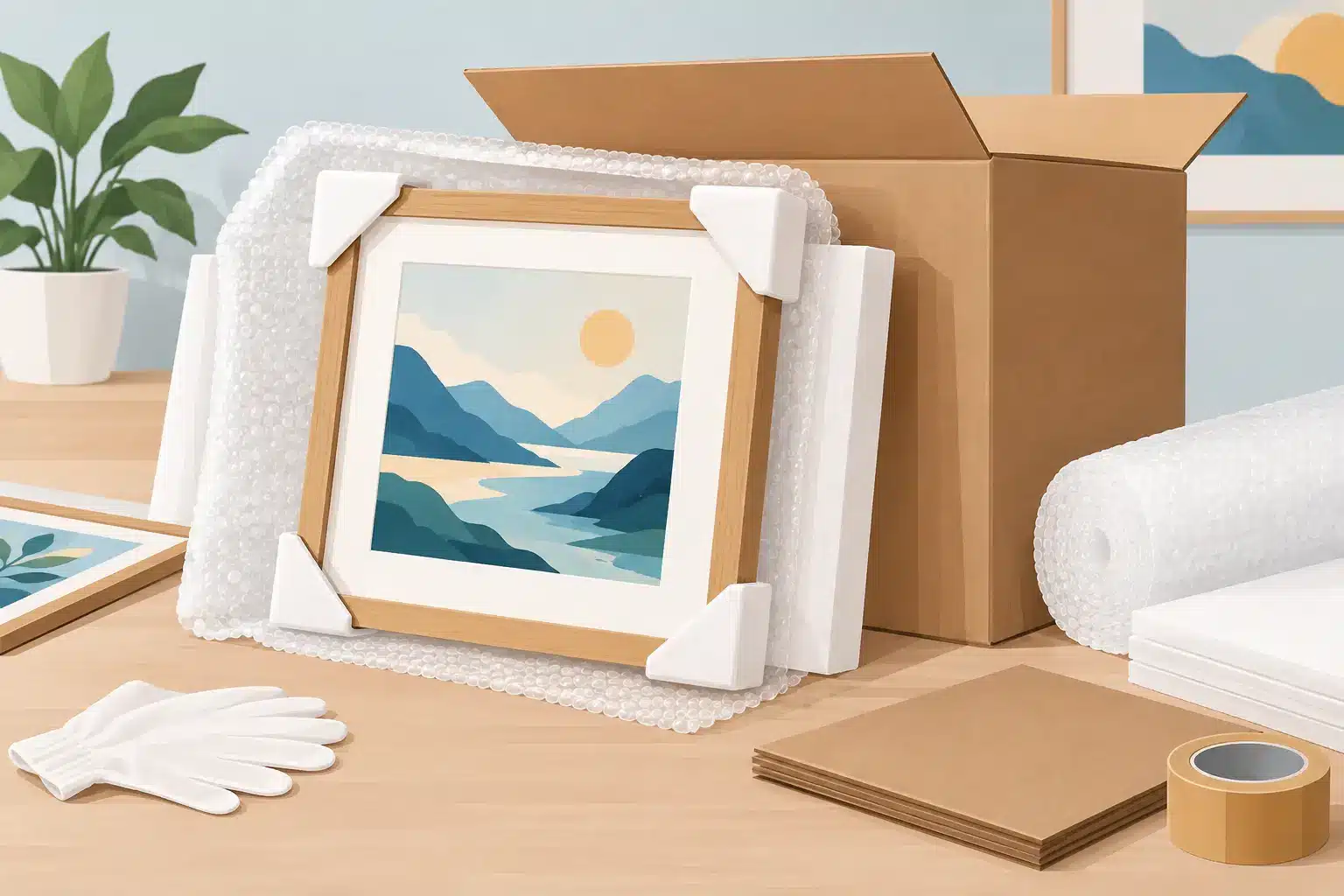
A bent corner, a cracked frame, or a scuffed canvas can take the joy out of sending artwork before the recipient ever sees it. Good artwork packaging is not about using the most materials possible. It is about choosing the right layers for the piece, giving it room to stay still, and protecting the areas most likely to get damaged.
Whether you are mailing a print, moving a family painting, selling a collectible poster, or dropping off work for a local event, packing art carefully helps preserve the time, talent, and memories behind it. The right approach depends on the artwork itself, especially its size, surface, frame, and value.
Start With the Artwork, Not the Box
Before gathering tape and cardboard, take a close look at what you are packing. A flat unframed print needs different protection than a framed watercolor, a stretched canvas, or a fragile shadow box. If the piece has loose parts, raised texture, glass, or a delicate finish, those details should guide every packing choice.
Measure the art at its widest points, including the frame. Then choose packaging that leaves enough space for padding without letting the piece slide around. A box that is too tight puts pressure on corners and glass. A box that is too large can allow the artwork to shift during handling.
For valuable, sentimental, or one-of-a-kind pieces, take a few photos before packing. This gives you a clear record of the artwork’s condition and can be useful if a carrier asks for documentation later.
Protect the Surface First
The first layer should prevent the artwork from rubbing against another material. For paintings, prints, and photographs, use a clean protective sheet between the art and any padding. Glassine paper is a good choice for many prints and photos because it is smooth and non-abrasive. Acid-free tissue can also work for certain pieces.
Avoid placing regular newspaper directly on artwork. Ink can transfer, especially if the item is exposed to heat, humidity, or pressure. Bubble wrap should not touch painted surfaces either. Its texture can leave marks on soft paint or stick to varnish in warm conditions.
A framed piece with glass needs special attention. Place painter’s tape across the glass in a large X, or create a light grid. This does not keep the glass from breaking, but it can help hold broken pieces together if damage occurs. Do not use tape directly on the artwork or frame finish.
For a canvas, protect the painted side with a smooth barrier, then wrap the full piece with bubble wrap. Keep the bubbles facing outward when possible, so the flatter side rests against the protective layer. This reduces the chance of texture pressing into the paint.
Corners Need Their Own Protection
Corners are usually the first place a frame gets dented or chipped. Add foam corner protectors, folded cardboard guards, or purpose-made edge protectors before wrapping the full piece. This small step is especially useful for framed posters, photographs, certificates, and mirrors.
If you are packing several flat pieces together, separate each one with rigid cardboard. Never stack framed art face-to-face without a barrier between them. The frames can rub, and pressure against the glass can cause trouble fast.
Choose Packaging That Matches the Format
The best artwork packaging often uses more than one layer. Think of it as a small system: surface protection, cushioning, rigid support, and an outer container.
For unframed prints, posters, and documents, a flat mailer with sturdy chipboard or corrugated cardboard is usually the safer choice. Keep the print flat unless it is specifically designed to be rolled. Rolling may save space, but it can create stubborn curls, creases, or stress along the paper fibers. For limited-edition prints or older posters, flat packing is often worth the extra cost.
For framed art, use a telescoping picture box or two appropriately sized boxes that fit together. Wrap the artwork, place it in the first box with padding around all sides, then put that box inside a slightly larger outer box. This double-box method creates a buffer against bumps and drops.
Stretched canvases need a strong box with clearance around the frame. Pad the corners, fill empty space with packing material, and make sure nothing presses directly against the canvas face. If the canvas is large, heavy, or valuable, a custom crate may be the better answer. It costs more, but it offers much stronger protection during long-distance shipping or storage.
For small original pieces, do not assume a small box is enough. Compact art can still get crushed if it is placed in a thin mailer or packed beside heavy items. Use rigid support and enough cushioning to keep it centered.
Fill Empty Space Without Adding Pressure
Once the artwork is inside the box, gently test for movement. If it shifts when you tilt the box, add more cushioning. Crumpled kraft paper, foam sheets, air pillows, and bubble wrap can all work well, depending on the piece.
The goal is to support the art from every side without squeezing it. Overpacking can be just as risky as underpacking. Too much pressure may crack glass, warp frames, or damage raised paint details.
Keep heavier materials on the outside of the protective layers. For example, a print may sit between cardboard sheets, surrounded by light cushioning, inside a rigid mailer. A framed piece may be wrapped, corner-protected, boxed, and then placed inside a second carton with padding around it.
Close the package with quality packing tape, not masking tape or clear office tape. Reinforce the bottom seams of heavier boxes, and apply tape across the top seams in both directions. A package can be packed beautifully inside and still fail if the box opens in transit.
Label Clearly, But Pack for Real Handling
Marking a package “Fragile” can be helpful, but it should never be the main protection plan. Packages move through trucks, sorting areas, counters, and delivery routes. Build the packaging as though it may be stacked, bumped, or turned sideways.
Use a clear shipping label on the largest flat side of the box. Remove or cover old labels and barcodes if you are reusing a box. If the artwork must stay upright, add orientation arrows, but remember that carriers cannot always guarantee a specific position.
For pieces with glass, write “Glass” and “Fragile” where it is easy to see. If the box contains an original or irreplaceable item, consider shipping options with tracking, insurance, and signature confirmation. The right choice depends on the artwork’s value, destination, and how comfortable you are with the risk.
When Local Help Makes Sense
Not every art project needs a custom shipping solution. A child’s drawing going to a grandparent, a framed graduation photo, or a print sold online can often be packed safely with the right box and a little patience. But if you are unsure about the fit, materials, or shipping service, in-person help can save a costly mistake.
At Liquid Books, customers can bring in artwork, prints, framed photos, and other special items for practical packing and shipping support. A local conversation is especially useful when the piece has unusual dimensions, fragile glass, or sentimental value that makes “good enough” packaging feel like a gamble.
A Quick Pre-Shipment Check
Before handing over the package, pause for one last inspection. Make sure the artwork cannot move inside the box, the corners have protection, and every seam is sealed. Check that the address is complete and readable, then keep your receipt and tracking details somewhere easy to find.
Artwork deserves a little extra care because it is rarely just an object. It may be a collector’s find, a family memory, a student’s first finished piece, or a gift chosen with real thought. Pack it like the person receiving it is already waiting to see it in perfect condition.
 Previous Post
 Next Post