


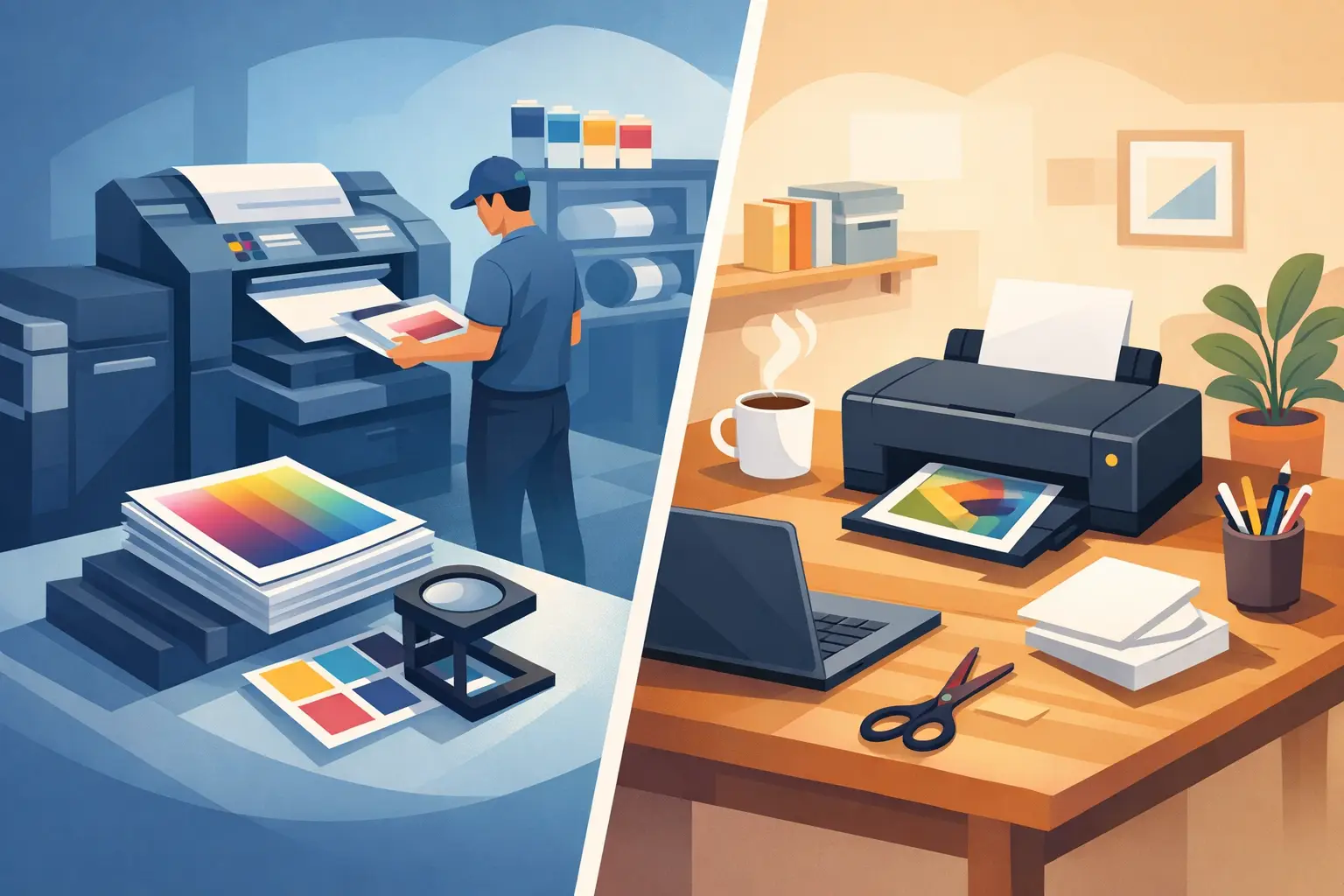
A print job can look simple until the home printer flashes a low-ink warning five minutes before school, work, or an event. When weighing a print shop versus home printer, the best choice is rarely about choosing one forever. It comes down to the job in front of you, the finish you need, and whether your time is better spent troubleshooting paper jams or getting on with your day.
For Manteno and Kankakee County families, students, collectors, and small businesses, both options have a place. A home printer handles quick, low-stakes pages well. A local print shop can save the day when the project needs to look polished, needs more copies, or simply cannot wait for a replacement cartridge.
Print Shop Versus Home Printer: Start With the Job
The easiest way to decide is to look beyond the number of pages. A one-page black-and-white form and 100 full-color flyers may both be “printing,” but they have very different demands.
Your home printer is usually the convenient choice for a permission slip, a return label, a recipe, or a couple of pages for class. You already have it, you can print at midnight, and there is no need to leave the house. If the document is plain and the deadline is flexible, that convenience is real.
A print shop makes more sense when appearance, consistency, volume, paper choice, or timing matters. Think resumes, presentations, event programs, yard sale signs, restaurant menus, color handouts, invitations, family memorial materials, and business forms. These projects deserve more than faded colors, streaky lines, or a paper stock that feels too thin for the occasion.
There is also a middle ground. You may print draft copies at home, then bring the final version in for clean, professional copies. That approach keeps revisions easy while making the finished piece something you feel good handing to customers, teachers, neighbors, or family.
The Real Cost Is More Than Paper and Ink
Home printing can feel free because the printer is already sitting on the desk. But ink and toner can be surprisingly expensive, especially for color-heavy work. A bargain printer may require cartridges that cost nearly as much as the machine itself, and some models use ink during cleaning cycles even when you are not printing.
Paper matters, too. Standard copy paper is fine for many jobs, but it is not the right fit for every project. Photos, postcards, certificates, double-sided brochures, and materials that will be handled often may need heavier or specialty stock. Buying several paper types for occasional use can leave you with half-used packages collecting dust in a closet.
At a print shop, you pay for the pages and options you need without maintaining equipment, stocking supplies, or replacing parts. For a handful of black-and-white pages, home may still be cheaper. For a larger run of color pages, the math often changes quickly. The better comparison is not just cost per page. Add cartridge replacements, wasted test prints, reprints caused by errors, and the value of your own time.
For small-business owners, there is another expense worth considering: materials that do not represent the business well. If a flyer has uneven color or a menu looks worn before it reaches the counter, reprinting costs more than money. It costs confidence.
Quality Shows Up in the Details
Most home printers can produce perfectly readable documents. That is all many everyday tasks require. But when a page needs to make a strong impression, commercial printing equipment and in-person guidance can make a visible difference.
Text should be crisp. Colors should be even from the first sheet to the last. Photos should not come out too dark, too blue, or washed out. Double-sided pages should line up correctly. Edges should be clean, and the paper should suit the purpose.
Those details are especially useful for materials that people keep. A graduation announcement, a keepsake photo page, a local event poster, or a packet for a job interview has a longer life than a disposable worksheet. A better print can make the project feel intentional rather than hurried.
Design files also create unexpected trouble. What looks centered on a phone or laptop may shift when printed. A file made for screen viewing may have blurry images, tiny text, or margins that are too close to the edge. At Liquid Books, customers can get face-to-face help with printing and graphic design rather than trying to solve every file issue alone.
Speed Is Not Always About Staying Home
A home printer wins when it is working properly and the job is small. You can send a document, pick it up seconds later, and move on. That is hard to beat for a single page.
But home printing becomes slower when the printer has not been used in a while, the ink is dry, the Wi-Fi connection drops, or the paper tray holds only a few sheets. Anyone who has tried to print 50 pages before leaving for an appointment knows how quickly “I’ll do it at home” can turn into a long detour.
A print shop is often faster for projects with several parts. Need copies collated? Want pages printed on both sides? Have a PDF on your phone but no easy way to connect it to your printer? Need a last-minute form faxed after it is printed? Handling those tasks in one stop can be far more efficient than making several attempts at home.
The key is planning ahead when the project has a firm deadline. Bring in or send the finished file with enough time for any needed corrections. If you are unsure about sizing, paper, or quantity, ask before printing the full run. A quick conversation can prevent a costly stack of copies that are not quite right.
When a Home Printer Is Worth Keeping
This is not an argument for getting rid of your home printer. For many households, it earns its space. It is useful for quick forms, occasional schoolwork, coupons, labels, and documents you need immediately.
A home printer is a good fit if you print often enough to keep the ink or toner from sitting unused, mostly need standard black-and-white pages, and do not mind managing supplies. It can be especially handy for families with students who regularly need short assignments or study sheets.
To make home printing less frustrating, keep one backup supply option on hand, use the right paper for the job, and print a test page before a time-sensitive project. Save your files as PDFs when possible so the layout stays consistent. These small habits reduce surprises.
Still, it is reasonable to treat your home printer as a convenience tool rather than a full production center. You do not need to force it to handle every project just because it is available.
When a Print Shop Is the Better Call
Choose a local print shop when the outcome matters more than the convenience of pressing Print from the couch. That is usually true for larger quantities, color documents, specialty paper, photos, professional materials, and anything with a deadline you cannot risk.
A print shop is also a smart choice when you need help, not just a machine. Maybe a parent emailed a document in an unfamiliar format. Maybe an older relative needs copies from a phone. Maybe a new business owner has an idea for a flyer but needs it cleaned up before printing. A person who can look at the file and explain the options is useful in ways a printer app is not.
Local service has another benefit: you can see and discuss the project. Instead of guessing how a color will look or whether a page should be single- or double-sided, you can make a practical decision with the finished use in mind. That is valuable for community groups, school events, neighborhood fundraisers, and small businesses working with limited budgets.
A Simple Way to Choose Before You Print
Ask yourself a few straightforward questions. Is this just for me, or will I hand it to other people? Do I need more than a few copies? Does color accuracy matter? Would a paper jam or low-ink message create a real problem? Do I need help getting the file, layout, or paper right?
If the answers point to a quick, basic document, print at home and keep your day moving. If they point to quality, quantity, or a project you cannot afford to redo, bring it to a print shop.
The best setup for many people is not print shop versus home printer as an either-or choice. Keep home printing for the small everyday tasks, and use a local print counter when the project deserves extra care. That leaves more room for the good parts of the day, whether that means finishing a business plan, getting ready for a school event, or heading home with time to enjoy a newly discovered book.
 Previous Post
 Next Post